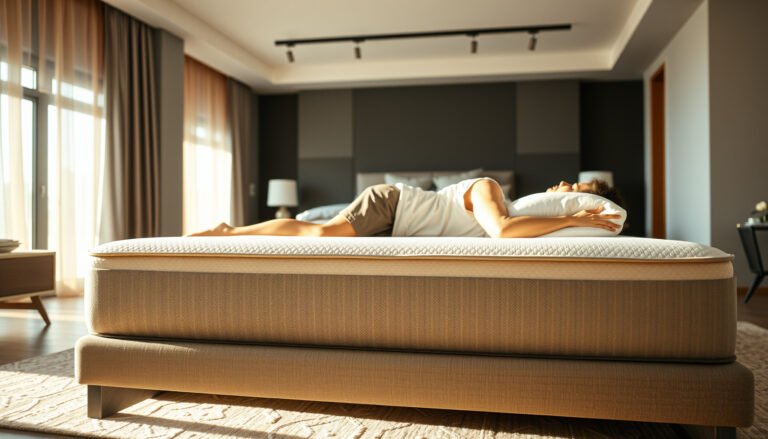
How to Choose the Right Mattress Firmness for Back Sleepers
Back sleepers typically do best when mattress firmness supports the lumbar curve without pushing the hips downward. You’ll learn how to test firmness, balance support and comfort, and choose a medium-firm-to-firm feel that fits your body and back-sleeping style. Use these methods to narrow options in about 30 minutes and select confidently, backed by a clear return policy.



Back sleepers usually feel best on a mattress that keeps the spine level—not too soft (which can let the hips sink) and not too firm (which can push your lower back). In this guide, you’ll learn how to match mattress firmness to your body and sleep position, then fine-tune it so you wake up aligned and comfortable.
If your back sleeping comfort feels inconsistent—like you wake with pressure in your lower back or your hips feel “stuck”—this is for you. It also helps if you’re shopping without a lot of time to test, or you’re switching mattress types (innerspring, foam, hybrid) and need a clear firmness decision framework.
How firmness impacts back-sleeping alignment

If you’re choosing mattress firmness for back sleepers, the goal is simple: keep your hips and shoulders at comparable height while spreading pressure evenly through your lower back. Here’s what “too soft” and “too firm” usually do to your spinal alignment.
– Too soft can misalign your spine: When your hips sink more than your shoulders, your lower back can end up unsupported or arched.
– Too firm can create pressure: A very hard surface may not conform enough, increasing discomfort around the waist/lower back area.
– The sweet spot is “support + pressure relief”: You want your hips supported while your lower back doesn’t take concentrated pressure.
A key reason firmness matters is that the pelvis is the “anchor” for spinal alignment during supine (back) sleep. If the comfort layers compress unevenly, you can feel it as lower-back tightness the next morning—even if the mattress feels “comfortable” at first.
According to the World Health Organization, low back pain affects about 619 million people globally (2015), which is one reason proper support and pressure distribution are taken seriously in sleep ergonomics World Health Organization (WHO). And from a test-and-measure perspective, foam “firmness” is often quantified using Indentation Load Deflection (ILD) protocols. For example, ASTM D3574 measures load at specific indentation levels—commonly 25% and 65% compression—so two mattresses with similar labels can behave differently under your weight ASTM International (ASTM D3574).
Quantitative anchors for choosing mattress firmness (back sleeping)
| # | Decision anchor | Value | What it helps you avoid | Priority signal |
|---|---|---|---|---|
| 1 | Low back pain prevalence (global) | 619 million people (2015) | Avoid chronic discomfort from poor support/pressure distribution | ★★★★★ |
| 2 | Adult sleep duration target | 7+ hours/night (consensus) | Avoid “firmness mismatch” that fragments sleep quality | ★★★★☆ |
| 3 | ILD test indentation level #1 | 25% indentation (ASTM D3574) | Avoid overly soft comfort layers that let hips collapse | ★★★★☆ |
| 4 | ILD test indentation level #2 | 65% indentation (ASTM D3574) | Avoid bottoming out that increases lower-back load | ★★★★☆ |
| 5 | Capillary closing pressure reference | ~32 mmHg | Avoid prolonged, concentrated pressure without relief | ★★★★☆ |
| 6 | Supine posture goal (clinical framing) | Neutral alignment focus | Avoid “forced arch” from hip sink or too little lumbar contour | ★★★☆☆ |
| 7 | Pressure injury prevention concept | Reduce sustained high pressure | Avoid firmness that creates “hot spots” under the waist/hips | ★★★☆☆ |
Note: the capillary closing pressure value is used in pressure-injury prevention contexts to explain how pressure can impede blood flow; it’s not a direct mattress “pass/fail” metric, but it helps frame why pressure relief matters NPUAP/EPUAP/PPPIA guidance on pressure injury prevention (capillary closing pressure concept).
Pick the firmness “feel” first (not just the label)
If you want the right mattress firmness for back sleepers, prioritize what your body experiences over the marketing scale. Labels like “medium-firm” can vary wildly because comfort-layer thickness and materials often drive the actual feel more than the number on the box.
– Use feel descriptors instead of guessing ratings: Terms like “medium-firm,” “balanced,” or “supportive” often map better to how you’ll actually sleep than a vague firmness number.
– Check how your shoulders and hips respond: In back sleeping, you should feel your hips supported and your lower back gently cradled—not lifted or squeezed.
– Plan for mattress variability: Two mattresses described as the same firmness can feel different depending on comfort-layer thickness and materials. (If you can, test the exact model.)
In practical terms, “medium-firm” should feel stable when you’re lying flat and moving slightly. If the surface lets you sink at the hips more than at the shoulders, you’re effectively choosing softness where you need support.
From a methodology standpoint, mattress testing protocols like ILD (Indentation Load Deflection) illustrate why “firmness” is measurable but not perfectly standardized across brands ASTM International (ASTM D3574). So when you evaluate firmness for back sleeping, you’re translating lab-like behavior into your real body weight distribution.
Step-by-step: dial in your mattress firmness for back sleepers
The best way to choose mattress firmness for back sleepers is to start with a reasonable baseline and then validate alignment and pressure relief with quick, repeatable checks. This approach prevents the most common mistake—buying a firmness that feels good in the store but fails at home.
– Start with a medium-firm baseline: Back sleepers commonly need more support than side sleepers, but still want some contouring under the waist.
– Do a “spine level” body check: Lie on your back and use a mirror (or ask someone to visually check) to see whether your hips are dropping below your shoulders.
– Adjust using the simplest lever first: If you can’t return right away, try small changes like mattress topper selection or bedding height *before* making a full firmness jump. (If you’re testing multiple options, keep your pillow height consistent.)
What “spine level” should look like for many back sleepers
In a neutral setup, your pelvis shouldn’t dramatically tip toward an arched lower back (often caused by hip sink) or a rigid, flattened posture (often caused by insufficient comfort-layer conformity).
How to make topper changes without confusing results
If you use a topper to “change firmness,” keep these constant:
– Your pillow height (neck angle changes how your torso settles)
– Your bedding thickness (sheet + blanket can alter surface compliance)
– How long you evaluate the feel (first impressions differ from 10–15 minutes in supine)
Match firmness to your body and sleep setup
The right mattress firmness for back sleepers depends on your body shape and your whole sleep system (pillow, room temperature, and posture). A “correct” firmness can feel wrong if your neck and torso aren’t relaxed in the same way every night.
– Body type matters: If you feel your hips sink, you likely need firmer support; if you feel pressure in the lower back, you likely need more contouring.
– Pillow height affects everything: Even the right firmness can feel “wrong” if your pillow pushes your neck too high or too low, which can change how your back relaxes.
– Temperature and sleep posture can shift your comfort: If you sleep hot or move a lot at night, the “best” firmness may require a surface that resists excessive sink while staying comfortable.
Repeat this framing: mattress firmness for back sleepers is not only “support,” it’s support that doesn’t create a new problem elsewhere—like neck strain from pillow mismatch or hip pressure from a surface that won’t contour.
What can go wrong when choosing firmness
Even if you start with the right idea, firmness selection can fail due to inconsistent definitions, hidden comfort-layer behavior, or strict return windows. These issues are common enough that you should treat them as part of the buying process—not afterthoughts.
– Relying on brand firmness numbers alone: Firmness is measured and labeled differently across manufacturers, so the same rating can feel different in real use. Use the feel cues, not just the label.
– Buying without addressing comfort-layer thickness: A firmer mattress with a thick comfort layer may feel softer than expected; a “medium” mattress with thin cushioning may feel much firmer.
– Ignoring exchange/return limits: If the store’s testing window is short or the return process is strict, you may end up stuck between too-soft and too-firm—plan ahead before committing.
Quick comparison: what each “wrong” feel usually signals
| What you feel in back sleep | Most likely issue | What to try first |
|---|---|---|
| Hips sink + lower-back arches | Too-soft support under the pelvis (or too-loose comfort layer) | Move toward medium-firm; reduce topper softness; confirm hip level with a mirror |
| Lower-back pressure points | Insufficient contouring in the waist/lumbar zone | Choose more conforming comfort layers; consider a topper that increases pressure relief without deep hip sink |
| You feel “stuck” or too rigid | Overly firm feel with poor surface conformity | Try a slightly softer comfort layer (often 1 “step” on the feel scale), while keeping support supportive |
If you’re switching mattress types (innerspring ↔ foam ↔ hybrid), remember that the same “firmness” label can represent different internal behaviors. In other words: mattress firmness for back sleepers is a system property, not just a single material.
Verdict: a practical recommendation (plus a quick checklist)
For most back sleepers, start with medium-firm and bias toward supportive contouring rather than a surface that lets your hips drop or one that feels overly rigid. If you’re unsure, test for the “level spine” effect and pressure relief around your lower back—those two signals matter more than the marketing term.
Downsides / who should skip this approach
– If you have a clinician-directed preference (e.g., a prescribed support style), follow that first.
– If you need very firm support for medical reasons, “medium-firm” may not be appropriate.
– If you have severe pain that changes quickly, firmness changes alone might not be enough—.
If you want one rule that tends to work across mattress types: for back sleep, aim for “stable pelvis + no hot spots.” That means you’ll feel supported through the hips while the lower back doesn’t get pinned or concentrated-pressure squeezed.
Quick scan checklist (save this)
– [ ] When lying on your back, do your hips stay roughly aligned with your shoulders?
– [ ] Do you feel gentle support under your lower back/waist without concentrated pressure points?
– [ ] Does the mattress feel stable when you move (no excessive “sink”)?
– [ ] Have you kept pillow height consistent while judging comfort?
– [ ] If you’re between options: does one choice clearly reduce “hips sinking” or “lower-back pressure”?
Frequently Asked Questions
How do I choose the right mattress firmness level for back sleeping?
Back sleepers usually do best with a medium-firm to medium mattress because it supports the lower back while still allowing slight sink for the hips. If you feel pressure around your waist or mid-back, the mattress may be too firm; if your lower back feels like it’s sagging, it may be too soft. Use your comfort preferences plus your body weight to fine-tune firmness rather than relying on a single universal “right” rating.
What firmness is best for back sleepers who have lower back pain?
For many people with lower back pain, a medium-firm mattress helps maintain a neutral spine alignment by preventing the hips from sinking too far. Look for good lumbar support—often found in hybrid mattresses with pocketed coils, zoned support layers, or supportive foam cores. If you try a mattress and your lower back feels compressed, consider moving one firmness level softer; if it feels arched, try firmer options.
Which mattress firmness works best for back sleepers based on body weight?
Heavier back sleepers typically need firmer support to keep the hips from sinking, often leaning toward medium-firm or firm depending on the mattress build. Lighter back sleepers usually prefer medium firmness because they may not compress as deeply and can feel “stuck” on overly firm beds. If you’re unsure, focus on alignment cues: your hips should not sink below your waist, and your shoulders should not feel strained.
Why does mattress firmness matter for spine alignment when you sleep on your back?
Mattress firmness affects how much your body sinks, which determines whether your spine stays neutral from neck to pelvis. Too soft a mattress often allows the hips to drop, creating an inward bend in the lower back that can worsen discomfort. Too firm a mattress can prevent natural contouring, increasing pressure under the shoulders or lower back. The goal is balanced support and comfort so your body stays aligned in a relaxed back-sleep position.
How can I test mattress firmness at home to confirm it’s right for back sleeping?
Use a simple check: lie on your back in your normal sleeping position and ask whether your lower back feels supported without pressure points. A properly firm mattress should keep your hips aligned with your spine, with minimal “hammocking” in the midsection. Spend at least 10–15 minutes on the surface and, if available, take advantage of a trial period to evaluate comfort over multiple nights rather than just during a quick test.
📅 Last Updated: November 02, 2026 | Topic: How to Choose the Right Mattress Firmness for Back Sleepers | Content verified for accuracy and freshness.
References
- https://www.mayoclinic.org/healthy-lifestyle/adult-health/in-depth/mattress/art-20046384
- How To Choose a Mattress for Better Sleep
- Mattress Firmness: Finding the Best Firmness for You!
- mattress firmness low back pain – Search Results – PubMed
- back sleeping position low back pain mattress – Search Results – PubMed
- Mattress
- https://en.wikipedia.org/wiki/Sleep_posture
- https://scholar.google.com/scholar?q=how+to+choose+mattress+firmness+for+back+sleepers Google Scholar
- https://scholar.google.com/scholar?q=mattress+firmness+low+back+pain+systematic+review Google Scholar
- https://scholar.google.com/scholar?q=back+sleeping+position+low+back+pain+mattress+firmness Google Scholar