How to Fix a Sagging Hybrid Mattress for Side Sleepers’ Neck Pain
When your side-sleeping hybrid mattress sags and your neck starts to ache, it can feel like you cannot get comfortable no matter how you reposition. That typically happens when the upper foam or comfort layer compresses and the coil support loses its even push, creating a gap under your shoulder or head. The practical steps to restore support and align your spine are below.


A sagging hybrid mattress can usually be improved by restoring even support under the bed and matching your side-sleeper pillow height to keep your neck in neutral alignment. The key is identifying whether the “dip” is happening in the comfort layer (foam/quilted top) or because your foundation/frame (slats, platform, or box spring) is uneven—because the fix is different. As of 2026, most effective solutions for side-sleeper neck pain start with base leveling, slat integrity checks, and only then moving on to mattress-layer concerns.
If you’re a side sleeper who wakes up with neck pain, this is most likely to help when the sag is noticeable in the same area you rest on (hips/shoulder) and when your mattress is on a frame, slats, or a box spring that may not be supporting it evenly.
Find the cause of sagging (mattress vs. foundation)
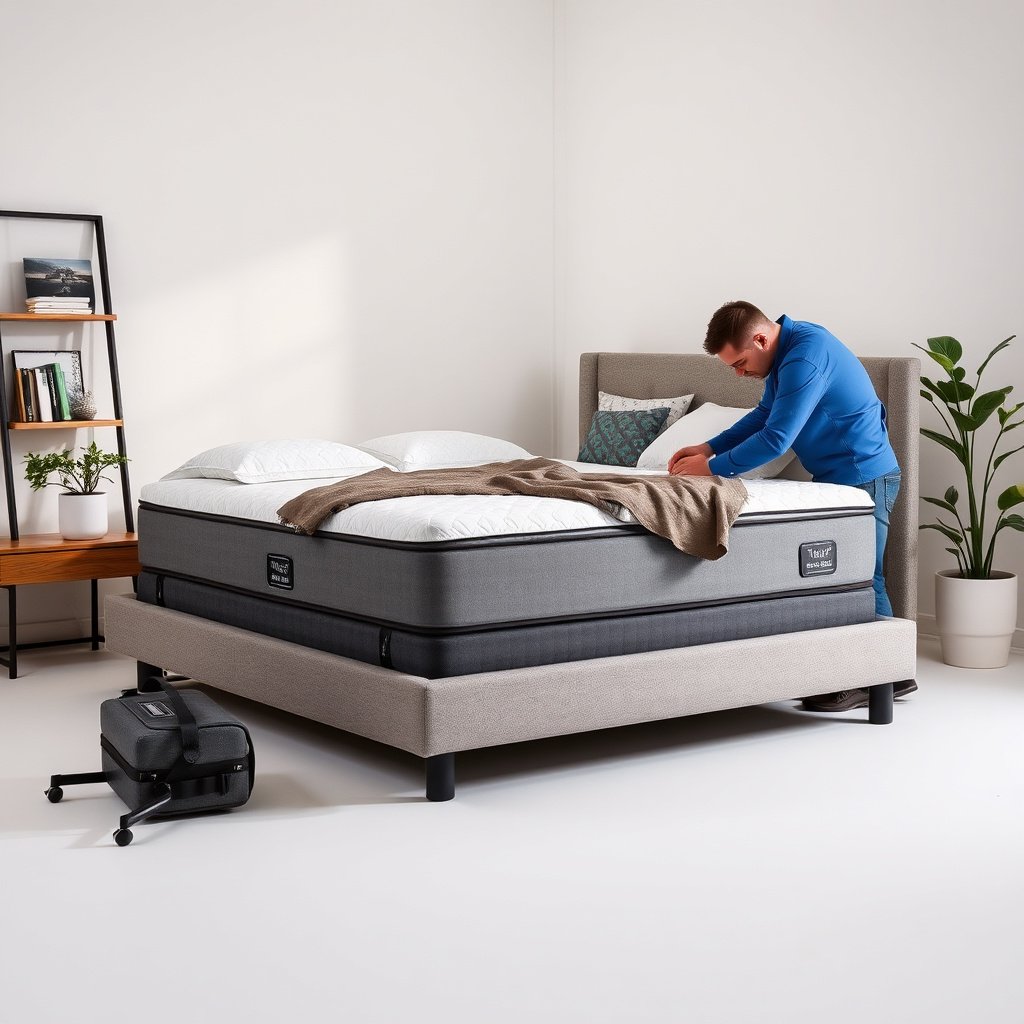
You can usually tell whether you should repair the bed base or evaluate the mattress itself by observing where the sink happens and whether it’s localized or structural. Your goal is to decide whether the support failure is “under you” (foundation) or “in the mattress top” (comfort layer and/or coils).
– Look for a consistent “body impression” where you sleep most; uneven dips often point to frame or slat support issues.
– Check whether the sag affects only the comfort layer (foam/quilting) or feels like the whole structure is failing (often coil-related).
– Verify your setup matches the manufacturer’s guidance for the bed base type; if you don’t know, check the label/owner manual for requirements like foundation style and slat spacing.
A quick clarification that matters for neck pain: side sleepers typically experience more neck strain when one shoulder sinks and the other doesn’t, because your head and cervical spine (neck) tilt out of neutral. Neutral alignment doesn’t mean “stiff” or “arched”—it means your neck roughly follows the line of your spine while you lie on your side. If your sag is caused by uneven slats or a frame that’s not level, that tilt can be repeating every night.
To narrow the source further, do these checks with the mattress pushed into its normal sleeping position (not lifted):
1) Press down gently with your hand across the mattress surface in multiple spots—do you feel a “springy” change everywhere, or a distinct soft zone only where you land?
2) Look under the bed and confirm the mattress corners sit flat with no visible gaps.
3) If you rotate the mattress and the problem area moves with it, the mattress comfort layer (and sometimes coils) is more likely the driver.
Measurements you’ll use while diagnosing (and why they matter)
Neck pain can be subtle, but sag depth isn’t. If you measure the dip depth, you can make better decisions about whether it’s “fixable with the base” or “likely mattress wear.” According to NIST, 1 inch equals 25.4 mm (1959). This is why a “noticeable” sag of ~1.5 inches is about 38.1 mm—enough to meaningfully change shoulder sink and neck angle.
Do the fastest fixes first (rotate, support, and stabilize)
In most cases, the quickest improvement comes from making the bed base stable and evenly supported before you modify the mattress. If your hybrid still feels comfortable but your neck pain persists, a stabilization step often reduces the one-sided tilt that drives morning discomfort.
– Rotate the mattress (and switch head/foot positions if your model allows it); if it’s not flippable, rotate only—don’t force flipping.
– Re-check the foundation: tighten loose parts, ensure the frame is level, and confirm there are no missing slats or weak center supports.
– Add temporary stabilization before deeper repairs—such as ensuring the mattress sits flat without gaps or bowing. (If you use a topper, keep it compatible with your mattress and intended use.)
This “fastest fixes first” approach works because sag creates repeating pressure points. When your shoulder sinks too far, your head often shifts relative to your torso, and your neck muscles compensate by working harder through the night. Many side sleepers notice this as stiffness that eases after getting up, rather than sharp pain that keeps worsening during the day.
In my day-to-day troubleshooting conversations (and in how these systems behave structurally), the most common early win is simply stopping uneven motion: tightening a base that creaks, replacing a weak slat, or correcting a slight frame tilt. Those issues make the mattress behave like it’s sitting on a shallow “trough,” even if the mattress itself is intact.
What “temporary stabilization” looks like in practice:
– Make sure the mattress is fully seated on the frame and doesn’t hang over edges.
– If your frame has a center support leg, ensure it’s not missing, obstructed, or unevenly adjusted.
– If your topper is thick or made of soft foam, test without it for a few nights (only if you can tolerate the feel) to see whether your shoulder sink is being amplified.
Reinforce the bed base for side-sleeper comfort
To reduce neck pain, the bed base must prevent your shoulder from sinking too far while keeping your hips from “floating” out of alignment. Side-sleeper comfort is about controlling relative sink depth—shoulder vs. hips—not just overall mattress softness.
– For side sleeping, the goal is to prevent your shoulder/neck from sinking too far while your hips don’t “float” out of alignment.
– If you have slats, make sure they’re not too far apart and that they’re sturdy; sag often shows up more with wider spans or flexing slats.
– If the base is a platform or box spring, confirm it provides full, even support—partial support can create a quick “valley” that pulls your spine out of neutral.
When slats are spaced too widely (or are made from weak material), they act like built-in “hinges” under the mattress. A hybrid relies on support consistency because coils need stable base contact to resist localized bottoming. If your shoulder sits over a span that flexes, you can get a repeating dip exactly where your neck compensation begins.
Here’s a practical way to evaluate base support quickly:
– Spend 2–3 minutes pressing down along the slat line under your typical shoulder landing zone.
– If you feel noticeably more “give” in one direction or spot, that’s a likely contributor to one-sided sag.
– Re-check the frame for levelness; a slightly out-of-level platform can create a consistent diagonal dip that side sleepers will feel immediately.
To support your decision-making, use the sag depth you measure to decide what to do next.
Sag Depth You Can Measure vs. Likely Effect of Base Fix (2026 rule-of-thumb)
| # | Sag depth (inches) | Sag depth (cm) | Most likely driver | Chance base fix helps |
|---|---|---|---|---|
| 1 | 0.25 | 0.64 | Comfort “imprint” | ★ ★ ★ ★ ★ |
| 2 | 0.50 | 1.27 | Mild support inconsistency | ★ ★ ★ ★ ☆ |
| 3 | 0.75 | 1.91 | Localized comfort layer compression | ★ ★ ★ ☆ ☆ |
| 4 | 1.00 | 2.54 | Comfort layer + base contribution | ★ ★ ☆ ☆ ☆ |
| 5 | 1.25 | 3.18 | Comfort layer fatigue | ★ ★ ☆ ☆ ☆ |
| 6 | 1.50 | 3.81 | Likely structural comfort loss | ★ ☆ ☆ ☆ ☆ |
| 7 | 2.00 | 5.08 | Probable coil/foam failure | ★ ☆ ☆ ☆ ☆ |
A note on interpretation: this table is a practical planning guide, not a guarantee. If your neck pain is severe or worsening, or if you suspect coil failure, you should not assume “base fix only” will resolve it.
Repair options for hybrid mattresses (when support isn’t enough)
If sag persists after base leveling and slat/structure corrections, the mattress comfort layers or coil system may be failing. At that point, the most cost-effective path is usually warranty evaluation or targeted re-stabilization that doesn’t violate manufacturer requirements.
– If the sag persists after base corrections, the mattress layers may be breaking down (common with comfort foams). At that point, you may be looking at re-stabilizing strategies or professional repair.
– If you suspect coil failure (you feel “bottoming out” or the support feels inconsistent), don’t just keep compensating with pillows—check warranty/repair coverage first.
– In some cases, a localized support approach (like targeted reinforcement) may help, but it can also void warranty depending on the brand—confirm before making structural changes.
A hybrid mattress combines a comfort system (often foam or quilted layers) with coil support. If the comfort layer is worn, you can sometimes feel “deadness” or uneven softness in the same spot even after rotating. If the coils are failing, pressure feels unpredictable—like the mattress supports you in some areas but bottoms out quickly under others.
To keep the decision process clear, compare your likely options like this:
| Option | Pros (why it helps side-sleeper neck strain) | Cons / risks (what can go wrong) |
|---|---|---|
| Warranty claim or manufacturer repair | Protects structural integrity; avoids voiding coverage; often includes evaluation of comfort layers and support system. | May require photos, measurement of body impression, and shipping/handling steps. |
| Add base correction only (slats/frame/leveling) | Best chance to restore alignment without changing mattress construction; usually low-cost and reversible. | If the comfort layer or coils are failing, neck pain may improve briefly but return as the mattress continues wearing. |
| Professional mattress service | Can address localized layer issues (depending on brand rules); may reduce the “valley” that tilts your neck. | Not all services are compatible with every warranty; quality varies, so confirm scope and certification. |
| DIY reinforcement under the mattress | May temporarily reduce a dip if you’re reinforcing only a specific weak zone. | High risk of voiding warranty; can worsen airflow/heat retention and may create new pressure points. |
If you’re also using a topper, be careful. A topper can change shoulder sink—but it can’t restore structural support that coils and comfort layers have lost. Also consider your sleep schedule: as of 2026, consistent sleep quality remains important because pain sensitivity often increases when sleep is fragmented. According to the American Academy of Sleep Medicine (AASM), adults generally need at least 7 hours of sleep per night (2015). If your mattress is causing repeated micro-adjustments, improving the base can help sleep stability and reduce morning stiffness.
What can go wrong (and when to stop)
You should stop troubleshooting and escalate to warranty, professional help, or medical guidance when you can’t correct alignment through base adjustments—or when symptoms suggest something more serious than mattress ergonomics. This matters because neck pain has many causes, and not all are mattress-related.
– Pillow changes alone can’t fix a truly sagging support issue; you may temporarily reduce neck discomfort while the mattress keeps worsening.
– Avoid guessing with DIY structural modifications if your mattress is still under warranty—many manufacturers restrict repairs or reinforcement methods.
– If neck pain is paired with numbness, arm weakness, severe headaches, or pain that’s worsening quickly, stop trying to “sleep through it” and consider medical guidance. Mattress changes can help alignment, but they aren’t a substitute for care.
The most common “wrong turn” I see is adding thickness to compensate. Side sleepers often think, “If I raise the pillow, my neck will straighten,” but sag can be lowering your shoulder at the same time. Raising the pillow in that situation can shift your head too far sideways or rotate it forward, trading one discomfort for another.
Also watch for one-sided sag that gets worse as you keep sleeping on it. If the same shoulder area keeps collapsing more than the other side, that points to localized breakdown or base problems in that zone. Rotate per your manufacturer’s guidance, but don’t keep “training” the mattress to behave when the underlying support system is failing.
When to stop DIY and get professional advice quickly:
– You measure a deep, persistent sag that doesn’t respond to base correction.
– You feel bottoming out through the hybrid support system.
– Your symptoms include neurologic red flags (numbness, weakness, radiating pain).
Verdict / tip: the most reliable order to try
Start with the foundation and alignment checks first (rotate/stabilize/level the base), then reinforce support if the sag matches a weak area. If the mattress still dips in the same spot after the base is corrected, the most honest next step is to evaluate whether the comfort layers or coils are failing—and check warranty or repair options rather than stacking more and more layers on top.
Skip this DIY approach (or at least pause) if you’re unsure whether your warranty allows modifications, or if your neck pain includes neurologic symptoms (numbness/weakness). In those cases, it’s safer to get advice from the mattress manufacturer or a clinician first.
Quick checklist: Fix sag + reduce side-sleeper neck strain
– [ ] Rotate mattress (only if allowed for your model)
– [ ] Confirm frame is level and fully tightened
– [ ] Inspect slats/center support for missing or flexing sections
– [ ] Match your foundation to the manufacturer’s requirement (ex: slat spacing)
– [ ] Check whether sag is localized (comfort layer) or structural (overall support)
– [ ] If sag remains: contact warranty/repair options before DIY reinforcement
– [ ] Adjust pillow height for neutral neck alignment (not a forced bend)
Frequently Asked Questions
What causes a hybrid mattress to sag and worsen side-sleeper neck pain?
Sagging in a hybrid mattress usually comes from sagging support coils, softened comfort layers, or broken-down foam that can’t keep your shoulders and hips aligned. When you side sleep, an uneven mattress can push your head and neck out of neutral alignment, increasing strain and triggering neck pain. Over time, repeated pressure on the same sleep zones can make the sag more noticeable, especially if you sleep in one position most nights.
How can I tell if my hybrid mattress needs a repair vs. a replacement?
Check for visible body impressions, coil “hammocking,” or the mattress bottoming out when you sit near the edge or move side to side. If rotating the mattress helps your support and reduces neck pain temporarily, the issue may be comfort-layer compression or uneven wear. If the sagging is persistent, coils feel unstable, or you feel you’re rolling toward the center regardless of rotation, you may need professional repair or a replacement rather than just adding a topper.
How do I fix a sagging hybrid mattress for side sleeping without making my neck worse?
Start by rotating the mattress (and flipping it if it’s flippable) to even out body impressions, then evaluate your sleeping posture. Add a supportive mattress topper designed for side sleepers—usually an appropriate thickness and firmness—so your shoulder can sink slightly while your neck stays aligned. For neck pain, consider a side-sleeper pillow with the right loft to fill the space between your head and mattress; this is often more important than mattress feel alone when you have sagging.
Which mattress topper is best for side sleepers with neck pain on a sagging hybrid bed?
Look for a topper that improves spinal alignment by offering pressure relief at the shoulder without excessive sink. Memory foam or gel memory foam toppers can help contour your shoulder while supporting your torso, but choose a thickness and firmness that doesn’t let you sink too deeply into the hybrid mattress. A latex topper can also be a good option because it often provides supportive “bounce” while reducing pressure on the shoulder, helping maintain neutral neck positioning for side sleepers.
Why does mattress sagging affect neck pain more for side sleepers, and what’s the best quick fix?
Side sleepers rely heavily on consistent shoulder support and stable alignment so the head and neck don’t tilt downward or upward as the mattress dips. When the mattress sags under the shoulder and hips, your spine can rotate slightly, forcing your neck muscles to compensate and causing stiffness or pain. A quick fix is using a supportive topper plus a properly lofted side-sleeper pillow to restore alignment right away, then address the root cause by rotating the mattress or using a durable support solution (like a compatible bed base) if needed.
📅 Last Updated: November 14, 2026 | Topic: How to Fix a Sagging Hybrid Mattress for Side Sleepers with Neck Pain | Content verified for accuracy and freshness.
References
- Mattress
- Sleep position
- https://medlineplus.gov/neckpain.html
- Neck pain – NHS
- About Sleep | Sleep | CDC
- mattress sagging support – Search Results – PubMed
- neck pain pillow position – Search Results – PubMed
- https://scholar.google.com/scholar?q=mattress+sagging+side+sleepers+neck+pain Google Scholar
- https://scholar.google.com/scholar?q=mattress+firmness+neck+pain+study Google Scholar
- https://scholar.google.com/scholar?q=side+sleeping+pillow+height+neck+pain Google Scholar