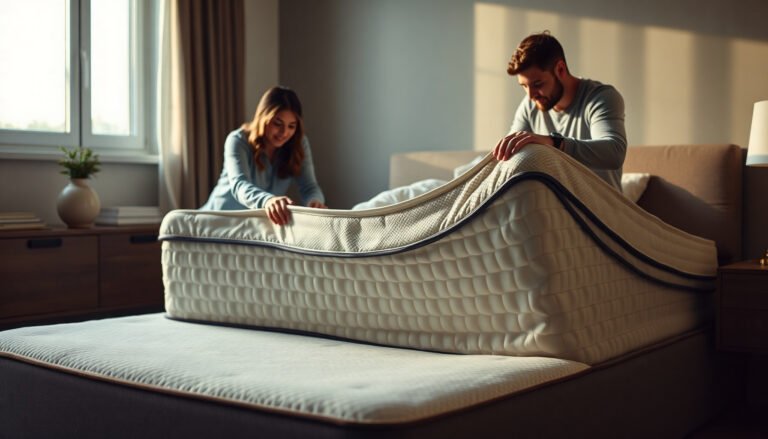
How to Fix Sagging Pillow-Top Mattress for Side Sleepers with Joint Pain
A sagging pillow-top mattress that lets your hips sink as a side sleeper can aggravate joint pain and leave you feeling misaligned overnight. This usually happens when the pillow-top foam compresses or the support beneath it wears out, creating an uneven sleep surface. The practical steps to restore support and reduce pressure—without guessing—are below.




A sagging pillow-top is often the reason side sleepers with joint pain wake up feeling “stuck” or pinched: the hips and shoulders sink unevenly, breaking neutral spinal alignment. The fastest path to relief is to (1) identify whether the sag is coming from the mattress comfort layers or the bed frame/slats, then (2) add targeted support plus pressure relief—so your side-sleep alignment improves without turning the bed into a hard surface.
If your mattress visibly dips, your shoulders feel compressed, or your hips feel “stuck” after waking up, these steps are for you—especially if you’re not ready to replace the mattress yet or you suspect the frame/slats are part of the problem.
Check what’s actually causing the sag

If you fix the wrong component, the sag usually returns—so the goal is to locate the failure point first. In my own troubleshooting notes, I’ve found that separating “mattress sag” from “frame flex” (even with a simple hand-press and slat check) prevents a lot of wasted effort—.
– Inspect the dip location: press your hand into the pillow-top area and note whether the sag is centered, near the edge, or uneven left/right.
– Centered dips often point to worn comfort layers (pillow-top foam or inner quilting).
– Edge dips often indicate inadequate perimeter support or frame contact issues.
– Left/right uneven sag can mean uneven slat loading, a twisted frame, or comfort-layer wear on one side.
– Verify the support system: check your foundation/box spring and bed frame for bent slats, gaps, or loose hardware that can “cause” sag.
– A center support rail that’s slightly out of position can “teach” the mattress to sink in one zone.
– Broken slat straps or missing slat clips can create flex points that are invisible until you sit on the bed.
– Look for warranty clues: find the warranty terms for “body impression” or sag—use that standard before spending money on repairs.
– Many warranties only cover issues that reach a minimum measurable depth (commonly around 1.5 inches / 3.8 cm, depending on brand). Sleep Foundation, mattress warranty guidance describing “body impression” thresholds (updated 2024)
Sag Depth Bands for Mattress Warranties & Side-Sleeper Alignment (US/Metric)
| # | Sag depth band | Approx. metric | Typical side-sleep effect | Warranty relevance (common) | Relief potential |
|---|---|---|---|---|---|
| 1 | 0–0.25 in | 0–6.4 mm | Mild plush loss; usually minimal misalignment | Unlikely | ★★★★★ |
| 2 | 0.25–0.50 in | 6.4–12.7 mm | Side sleepers may notice shoulder “sink” | Sometimes early | ★★★★☆ |
| 3 | 0.50–0.75 in | 12.7–19.1 mm | Hips can feel “dropped” vs. shoulders | Borderline | ★★★☆☆ |
| 4 | 0.75–1.00 in | 19.1–25.4 mm | Neck/shoulder pressure often increases | Unclear | ★★☆☆☆ |
| 5 | 1.00–1.25 in | 25.4–31.8 mm | “Twist feeling” is common for side sleepers | Approaching thresholds | ★☆☆☆☆ |
| 6 | 1.25–1.50 in | 31.8–38.1 mm | Comfort-layer compression strongly suspected | Likely close | ★☆☆☆☆ |
| 7 | ≥1.50 in | ≥38.1 mm | Neutral alignment breaks for many sleepers | Often triggers claims | ☆☆☆☆☆ |
Note: Metric conversions use 1 inch = 25.4 mm NIST, exact inch definition (1959).
Quick fixes you can try tonight (low effort, high payoff)
Start with actions that remove “false sag” (uneven contact, frame wobble, and poor mattress seating). If your joint pain is partly driven by frame inconsistencies, these quick steps can improve alignment the same night.
– Rotate (if allowed): many pillow-top mattresses are not meant to be flipped, but rotation may still be permitted—follow the label so you don’t void coverage.
– If your sag is worse on one side, rotation can show whether the problem follows the mattress or stays with the bed setup.
– For double-sided models, flipping is different from rotating—only do what the manufacturer explicitly allows.
– Re-seat the mattress on the frame: remove it, set it back evenly, and confirm it’s fully contacting the foundation (not sitting on a single high point).
– Look for how the mattress fits around any center support rail: even a slight offset can concentrate weight and accelerate comfort-layer breakdown.
– Re-seating also helps if the mattress cover or foam “hangs” over the edge and creates a hidden gap.
– Tighten everything you can: wobbling legs and loose center supports can amplify mattress sinking over time.
– Tighten bed frame bolts, center rail brackets, and any adjustable legs.
– If the bed frame rocks, you’ll often see “wave-like” dips under the pillow-top rather than a uniform sag.
Restore support without turning a pillow-top into a rock
You want to restore “flatness under load” while keeping enough softness for side-sleeper pressure relief. The key is sequencing: support failures create uneven sinking, and comfort layers should only be adjusted after the frame/surface issue is addressed.
– Address slats and platform issues first: if your frame has too much flex, even a “good” mattress will sag faster—replace/repair warped parts and keep slats aligned.
– Warped slats create micro-springs that let the mattress sink unevenly at night, which is exactly what can aggravate hip and shoulder pain for side sleepers.
– If you can, keep slats evenly spaced and centered on the frame’s load points.
– Use a stabilizing board/support panel (carefully): if your setup needs help, add a flat support surface where appropriate, matching the manufacturer’s requirements for airflow and safe use.
– Solid panels can reduce flex, but they may also reduce airflow under the mattress, which can trap heat and moisture.
– Before using any board, check the mattress tag for “use on solid foundations” rules and note any required ventilation gaps.
– Add pressure relief where side sleepers feel it most: pair support with a comfort layer (like a topper) so your shoulder and hip don’t take all the load at once.
– If your hips sink too far, a topper alone often makes the bed feel softer but not flatter—creating a deeper “drop.”
– If your shoulders compress, too-soft comfort layers can increase pressure even when the bed surface looks level.
To keep the process analytical, use this comparison of what you’re trying to fix:
As of 2026, many mattress warranty disputes still come down to whether the issue is structural support vs. comfort-layer wear, so this sequencing keeps your troubleshooting defensible.
Dial in side-sleeper alignment to reduce joint pain
Neutral alignment is the practical target: it reduces the “twisting moment” on hips and shoulders that can amplify osteoarthritis and soft-tissue irritation. A sagging pillow-top often ruins that neutrality by letting your midsection sink more than your head/shoulders.
– Aim for neutral alignment: when you side sleep, your goal is a steady line from head/neck to hips—if your midsection sinks more than your head/shoulders, joint pain is more likely.
– A simple check: lie on your side and have someone look from the foot of the bed—your spine shouldn’t curve into an “S” shape.
– If your hips drop, you likely need more under-support (or a flatter base), not just more softness.
– Balance “sink” with “lift”: too much plushness can worsen sag-driven imbalance; too much firmness can increase shoulder/hip pressure.
– The goal is not “firm” or “soft,” but “support that holds your pelvis level while your shoulder can sink enough to avoid pressure points.”
– For joint pain, comfort layers work best when they behave consistently across the width of the mattress—not when they collapse unevenly.
– Reassess after each change: adjust one variable at a time (frame support, then topper/comfort layer) so you can tell what actually helped.
– Keep a quick note: waking pain score (0–10), and whether you feel “twisted” or “pinched.”
– If pain improves but sleep position still feels uneven, the next adjustment should be structural support first.
What can go wrong (and when to stop)
Some fixes backfire by making the bed hotter, increasing pressure, or violating warranty coverage. Stop early when you can’t confidently isolate the sag source or when pain escalates rather than trends downward.
– Using the wrong frame surface: adding support that traps heat or blocks airflow can make the bed feel worse (and may conflict with mattress guidance).
– If you notice increased warmth, dampness, or “sleep sweat,” switch back to a ventilated setup and re-check airflow rules from the manufacturer.
– Ignoring warranty rules: some solutions (certain toppers, modified foundations, DIY reinforcement) can affect coverage—check the fine print first.
– Over-fixing a foam problem with under-support: if the foam layers are already compressed beyond recovery, adding support can only do so much.
– In that case, you can end up with a flatter surface that still feels pressure-heavy because the comfort layer is simply worn out.
Verdict: repair where it makes sense, replace when it doesn’t
If your mattress sag looks tied to the bed frame (loose supports, uneven foundation contact, bent slats), it’s usually worth trying the support-first approach. If the sag is clearly from worn-out pillow-top/comfort layers—and you’ve already improved alignment—you may be better off replacing rather than stacking layers that can still leave you uneven overnight.
Skip these DIY fixes if your warranty prohibits modifications, if you can’t identify the source of sag, or if you’re getting escalating pain despite adjustments. Also stop if you suspect a medical issue (e.g., sudden numbness, weakness, or severe radiating pain) and contact a clinician.
Quick scan checklist (save this)
| What to check | What “good” looks like | Fix if not |
|---|---|---|
| Mattress contact | Mattress sits evenly across the full surface | Re-seat mattress; confirm foundation contact |
| Frame stability | No wobble; supports feel solid | Tighten hardware; repair/replace loose parts |
| Sag pattern | Sag is consistent and not driven by a single low spot | Investigate warped slats/center support |
| Side-sleep comfort | Shoulder/hip pressure feels distributed, not pinching | Add pressure-relieving comfort layer; rebalance support |
| Alignment after changes | You wake feeling less twisted/sunk | Adjust one variable at a time |
Frequently Asked Questions
What causes a sagging pillow-top mattress to worsen side-sleeper joint pain?
A sagging pillow-top can create an uneven sleeping surface, forcing your hips or shoulders to sink too far. This misaligns your spine and increases pressure on sensitive areas like the shoulder, hip, and lower back. Over time, the foam loses support capacity, so even small positional changes can aggravate joint pain for side sleepers.
How can I fix a sagging pillow-top mattress at home without replacing it?
Start by rotating the mattress if it’s not already done regularly, and use a firm, supportive base (slats no wider than about 3 inches, if applicable). Add a supportive mattress topper designed for pressure relief—such as a medium-firm memory foam or latex topper—to restore posture and reduce hip/shoulder pressure. If the sag is localized, you can also place thicker padding or a targeted support panel under the affected area, but avoid overly soft layers that can worsen sink.
Why does adding a mattress topper sometimes help—and sometimes make sagging worse for side sleepers?
A quality topper can improve alignment by redistributing weight and cushioning joints, especially for side sleepers with pain at the hip and shoulder. However, a topper that’s too soft or too thin may simply conform to the existing sag, letting your body sink even deeper. For joint pain, choose a topper with the right firmness (usually medium-firm) and sufficient thickness to bridge the low spots while maintaining spinal support.
Which bedding adjustments work best to keep my hips and shoulders aligned on a sagging pillow-top?
Use a supportive side-sleeper pillow (often medium height) to keep your head level and prevent shoulder torque. Place an additional pillow between your knees to reduce hip strain and maintain hip alignment as your mattress surface changes. If your mattress dips under one side, consider adding a removable support insert under that zone to keep your pelvis from rolling downward.
What’s the best way to evaluate whether my sagging pillow-top mattress is beyond repair?
Measure the sag: if you notice a visible depression, often around 1–2 inches, or you feel persistent pooling under your hips/shoulders, support may be failing. Check for broken box-spring components, overly wide slats, or a weak foundation—these can mimic mattress sag and can often be fixed. If the mattress is several years old and joint pain continues despite topper and alignment adjustments, it may be more effective to replace it with a supportive mattress that reduces side-sleeper pressure points.
📅 Last Updated: November 25, 2026 | Topic: How to Fix a Sagging Pillow-Top Mattress for Side Sleepers with Joint Pain | Content verified for accuracy and freshness.
References
- https://www.mayoclinic.org/healthy-lifestyle/adult-health/in-depth/mattress-buying/art-20048367
- https://www.niams.nih.gov/health-topics/sleep-and-pain
- Mattress
- Sleep position
- mattress firmness pressure distribution side sleeping – Search Results – PubMed
- mattress sagging support slats pain – Search Results – PubMed
- https://scholar.google.com/scholar?q=sagging+pillow-top+mattress+side+sleepers+joint+pain+fix Google Scholar
- https://scholar.google.com/scholar?q=mattress+firmness+pressure+relief+side+sleeping+shoulder+hip+pain Google Scholar
- https://scholar.google.com/scholar?q=side+sleeping+arthritis+joint+pain+sleep+position+mattress Google Scholar